Through a public records request, I obtained the New Orleans Police Department’s drone flight logs covering January 1 through April 1, 2026. These are the department’s own records, exported from its Skydio flight management system. What they show is a surveillance program operating largely outside its own rules — and an oversight process that declined to do anything about it.
The rules NOPD wrote for itself
NOPD’s drone program is governed by Chapter 43.5 of its Operations Manual. The policy is clear about the terms under which the department gets to put cameras in the sky: drones “shall be deployed only for specific public safety missions.” The policy enumerates the approved uses — responding to calls for service, hazmat incidents, search and rescue, crash and crime scene documentation, and so on.
The policy also imposes documentation requirements. Every non-DFR mission requires supervisor approval. Every deployment must be documented in a post-flight report, and the first required field is “the type of incident (i.e., the reason for the flight).” Those reports are supposed to be reviewed by a program coordinator and published on a public dashboard.
This is the bargain: NOPD gets aerial surveillance capability, and in exchange the public gets a paper trail showing each flight served a legitimate purpose. The logging requirement isn’t bureaucratic trivia — it’s the only mechanism that lets anyone verify the “specific public safety missions” limitation means anything.
What the logs actually show
The logs contain 273 flights over the three-month period. Of those:
- 206 flights — 75% — have no reason logged at all. The “type of incident” field is simply blank.
- 8 flights list only “event overwatch.” Overwatch is not a reason; it’s a description of a camera pointed at people. It answers none of the questions the policy requires: overwatch of what event, authorized by whom, for what purpose?
- 1 flight is logged with a single word: “PROTEST.”
That last one deserves attention. Chapter 43.5 has specific safeguards for First Amendment assemblies: drones may not be used to intimidate participants or collect data on people for non-criminal activity, the supervisor must notify the Orleans Parish Communication District, and NOPD’s Public Information Office must publicly announce the drone use before the flight. A one-word log entry makes it impossible to verify that any of these safeguards were followed — which is precisely the problem with skipping the paperwork.
I filed a complaint. Here’s what happened.
Since these are documented violations of NOPD’s own policy, I filed a formal complaint with the department’s Public Integrity Bureau (original complaint), tracked as 2026-0046-O.
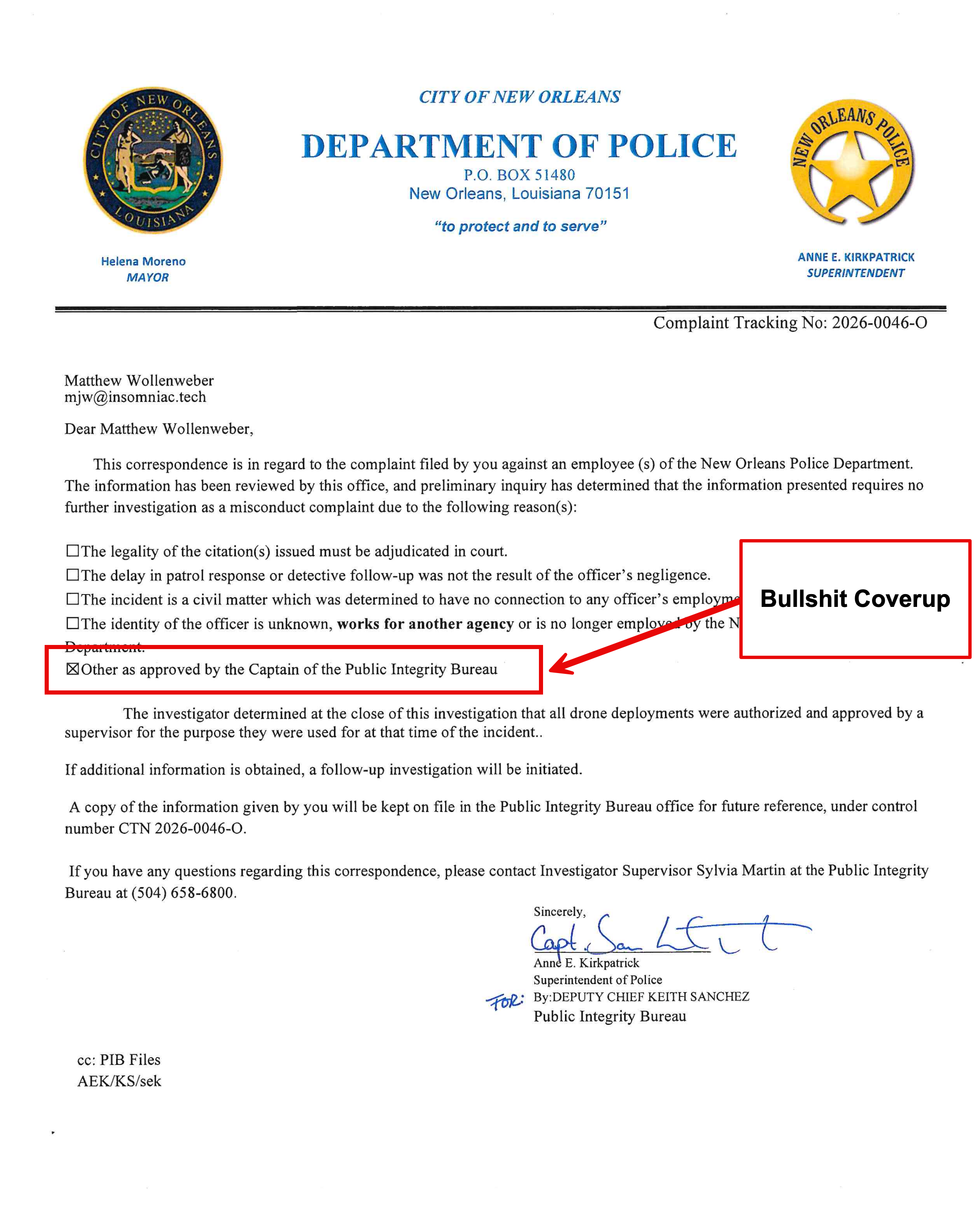
The response came back in a form letter (full letter here). After a “preliminary inquiry,” PIB determined the complaint “requires no further investigation.” The stated basis:
“The investigator determined at the close of this investigation that all drone deployments were authorized and approved by a supervisor for the purpose they were used for at that time of the incident.”
Sit with that. The records show no documented purpose for 75% of flights. The oversight body’s response is that every flight had a proper purpose — asserted without producing a purpose for a single one of the 206 blank entries. If supervisors did approve these flights for legitimate purposes, that documentation should exist and should have been trivial to cite. It wasn’t.
Look at how the complaint was actually dismissed. The letter is a form with checkboxes for standard dismissal reasons — the matter belongs in court, the officer works for another agency, and so on. None of those applied, because the complaint was well-founded. So PIB checked the last box: “Other as approved by the Captain of the Public Integrity Bureau.”
That’s not a finding. It’s not a rule, a policy citation, or an explanation. It is, literally, “because the Captain said so.” The body charged with enforcing NOPD policy was handed proof the policy wasn’t being followed, and its answer was that a captain approved not caring. There was no apparent review of the 206 undocumented flights, no request for the missing post-flight reports, no explanation of how an investigator “determined” purposes that were never written down. PIB didn’t conclude the policy was followed — it decided that not following the policy was fine. An oversight body that can waive the rules by checkbox isn’t overseeing anything.
Why this matters beyond paperwork
It would be easy to dismiss this as a records-keeping quibble. It isn’t, for three reasons.
First, undocumented surveillance is unaccountable surveillance. The same policy that requires flight logging also requires warrants for surveillance implicating a reasonable expectation of privacy, restricts targeted surveillance to enumerated serious crimes, and limits data use to authorized purposes. If the department skips the foundational requirement — writing down why the drone flew — there is no way to audit compliance with any of the rest. The logging requirement is load-bearing.
Second, the failure is systemic, not incidental. One missing entry is an oversight. Two hundred six out of 273 is standard practice. This happened across three months, across many pilots, under supervisors who are required by policy to manage every deployment.
Third — and most troubling — the accountability mechanism ratified the violation. The Public Integrity Bureau exists to correct exactly this kind of departure from policy. Presented with documented, quantified, systematic non-compliance, it closed the complaint without requiring the department to change anything. A policy that isn’t followed is a press release. An oversight body that won’t enforce it is permission.
What you can do
NOPD has told us, in writing, that it sees no problem here. That means the correction has to come from the officials NOPD answers to.
If you live in New Orleans, contact Mayor Helena Moreno’s office and your city council member. Ask them two questions:
- Why do 75% of NOPD drone flights from January through April 2026 have no logged reason, when Chapter 43.5 requires one for every deployment?
- Why did the Public Integrity Bureau close complaint 2026-0046-O without addressing the missing documentation?
City Council contact information is at council.nola.gov, and you can find your district member there. The mayor’s office can be reached through nola.gov.
The documents are linked above — the complaint and PIB’s response. Check my numbers. Then make the call.
